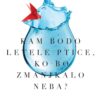
If Adriana Kuči’s debut novel, My Name Is Sarajevo (Ime mi je Sarajevo), explored the consequences of war, Lili Bosniae is a novel about its lingering traces – about what remains in the blood, the body, silence, and the ways in which we approach one another.
At the centre of the novel are Lejla, Lili, and Ajša, three women who recognise themselves in one another through loss, a sense of not belonging, and perseverance. Their stories lead from Sarajevo and Ljubljana to Darfur, while a distinctive layer of the novel reaches back into medieval Bosnian history and to Jelena Gruba, one of the women around whom history has left little but an absence.
Stylistically, Lili Bosniae is a mature, lyrical, and multilingual novel. The organic movement between Slovenian and Bosnian also speaks of an identity composed of different voices, memories, and homelands.
Lili Bosniae is a novel about how a person survives history – and how history survives within a person.
🔴 DOUBLE AWARD NOMINATION FOR MY NAME IS SARAJEVO
Adriana Kuči gained significant critical recognition with her first novel written in Slovenian, Ime mi je Sarajevo (My Name Is Sarajevo). The novel was nominated for two major Slovenian literary awards:
-
Cankar Award 2023 – nomination for the best original literary work of the previous year.
-
Best Literary Debut Award at the 38th Slovenian Book Fair (2022) – My Name Is Sarajevo was among the five nominated debut works.
The novel was also reprinted and translated into Croatian. Lili Bosniae thus continues the literary journey of an author whose writing attracted attention from both readers and literary critics from the publication of her first Slovenian novel.
Bukla: Three Questions for Adriana Kuči
In issue 194 of Bukla magazine, published in June 2026, Renate Rugelj interviewed Adriana Kuči. The conversation focuses specifically on Lili Bosniae: the intertwining of different women’s destinies, the Bosnian lily, Jelena Gruba, war, belonging, and literature as a space in which silenced stories can speak again.
In the interview, Adriana Kuči says:
“History tells us what happened. Literature, however, can help us understand what it was like to live through those events.”
And further:
“History remembers kings, wars, and borders, while literature remembers people. I have always been interested only in people.”
The conversation also captures one of the novel’s central ideas: people are not defined solely by their wounds, but also by what they manage to preserve despite those wounds – the capacity to love, to care for others, and to persevere.
Bukla – Three Questions: Adriana Kuči: Read the interview in Bukla
Reviews:
Renata Vidic, Dobre knjige
“No One Is Merely the Story of Their Pain.”
Published on 10 July 2026.
Renata Vidic particularly highlights the author’s sensitivity to her characters’ inner worlds, family rifts, silences, and the search for a way beyond the past.
“Writing imbued with sensitivity, revealing a refined understanding of the subtle emotional states of human beings, as well as the author’s own personal depth and maturity, will particularly resonate with readers who also know how to read silence.”
Dobre knjige – Lili Bosniae / Renata Vidic: Read the review on Dobre knjige
Maja Drolec, Jantarna lastovka
The Bosnian Lily as a Symbol of Survival
Published on 9 July 2026.
Maja Drolec foregrounds the intertwining of intimate and historical memory, and the women whom history has preserved only through their absence.
“The author enters precisely these gaps: where history falls silent, literature speaks.”
The Bosnian lily emerges as an image of survival: fragile yet persistent, vulnerable yet indestructible.
Jantarna lastovka – Maja Drolec: Read the review “The Bosnian Lily as a Symbol of Survival”
Matic Slapšak
Lili Bosniae
Published on 20 July 2026.
Rating: 5/5
Matic Slapšak describes the novel as Adriana Kuči’s best work to date, particularly highlighting the skilful interweaving of stories, character development, and the lyrical quality of its language.
“While reading this novel, I thought more than once that we had our own Elif Shafak.”
He concludes:
“Lili Bosniae is a novel that will probably leave you emotionally drained and, at the same time, fulfilled. It is certainly a novel you will not forget.”
Matic Slapšak – Lili Bosniae: Read Matic Slapšak’s review
Radio AGORA: Generatorji zgodb (Story Generators) – Adriana Kuči
The novel Lili Bosniae was also the subject of an almost hour-long episode of Generatorji zgodb (Story Generators) on Radio AGORA 105.5, broadcast on 9 June 2026. The conversation was hosted and edited by Gabriela Babnik Ouattara.
The discussion moves from Lejla, Lili, and Ajša towards the Bosnian queen Jelena Gruba and broader questions of the body, memory, belonging, motherhood, family rifts, and the legacy of trauma.
The historical dimension of the novel is not merely a reconstruction of the past. Writing about Jelena Gruba also becomes an act of resistance against historical silence and an attempt to create, through literature, a space for women’s voices that have been erased from history.
As the novel is introduced in the programme:
“Lili Bosniae is not merely the story of an individual woman, but a reflection on perseverance, memory, and the possibility of rediscovering our own place in the world through writing.”
Radio AGORA – Generatorji zgodb, Adriana Kuči: Lili Bosniae: Listen to the programme
A Novel About Inherited Wounds – and the Tenderness That Survives
Responses to Lili Bosniae converge on one important point: history in the novel is not merely a backdrop, but something that lives within people. In blood. In language. In silence. In the relationship between mother and daughter. In the feeling of never quite belonging to a single place.
Yet Adriana Kuči does not allow her protagonists to remain merely bearers of pain. She is also interested in what they manage to preserve despite their losses: tenderness, the capacity for closeness, and perseverance.
The Bosnian lily thus remains the novel’s central image: fragile, vulnerable, yet indestructible.