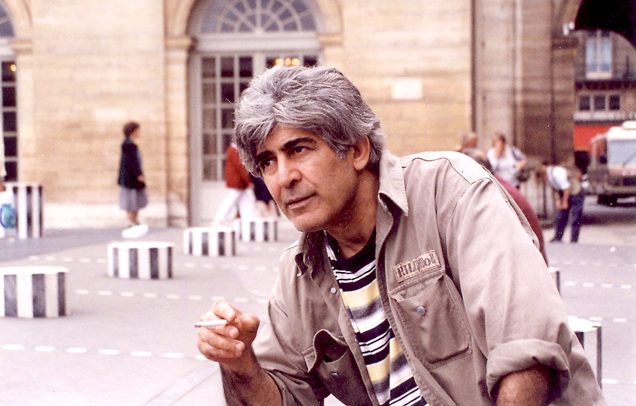
With the poetry collection The Knife Sharpener, Sargon Boulus (1944–2007), one of the most important and influential contemporary Iraqi and Arab poets, is introduced to a wider Slovenian readership for the first time.
Boulus’s poetry emerges at the intersection of exile, memory, war, cities, and the ceaseless search for home. His verses are clear and restrained, yet beneath their simplicity lies an immense historical weight: Iraq, Kirkuk, Beirut, San Francisco, Berlin, and the journeys between them become the inner geography of a person who can never again fully belong to a single place.
The Knife Sharpener is the poetry of a person on the move – but also poetry about what remains within us of places, people, and history after we have left.
The Slovenian edition is based on Boulus’s selected poems, which the poet himself translated from Arabic into English. They were translated into Slovenian by Gabriela Babnik Ouattara. Most of the poems were written between 1991 and 2007, while the English-language selection, Knife Sharpener, became a kind of final testimony by the poet.
🔴 ONE OF THE MOST IMPORTANT VOICES IN CONTEMPORARY ARABIC POETRY
Boulus began publishing as early as 1961 in the influential Beirut-based journal Shiʿr, which played a decisive role in the modernisation of Arabic poetry. He later lived in San Francisco, translated numerous major modern poets writing in English into Arabic, and became an important point of reference for younger generations of Arab poets.
Khalid al-Maaly described him as follows:
“A pivotal poet and perhaps the most important contemporary poet after al-Sayyab.”
He added that Boulus “radiates” in his poems, while his thought is woven with rare care.
Kadhim Jihad Hassan wrote:
“With the arrival of Sargon, Arabic poetry witnessed a rare phenomenon: a poet who devoted his entire life, thoughts, and human capacities exclusively to poetry.”
Pat Boran: A Life Composed of Poetry
The introduction to the English edition of Knife Sharpener was written by the Irish poet and publisher Pat Boran.
His essay opens with one of the most beautiful descriptions of Sargon Boulus:
“There are not many people of whom one can truly say that they are poets – in the sense of an individual whose entire life seems to be devoted to, even composed of, poetry.”
Boran recalls meeting Boulus at the Dublin Writers Festival in 2003, shortly after the beginning of the Iraq War. Instead of the expected direct political statement, the audience encountered something deeper: a perspective on history, the role of the writer, and the burden a person carries through time.
Read the Slovenian translation of Pat Boran’s introduction on Jantarna lastovka
Margaret Obank: When He Spoke About Poetry, He Opened Like a Rose
Margaret Obank, the long-standing editor of Banipal magazine, described Boulus through an exceptionally vivid image:
“When he began talking about poets and poetry, he opened like a rose – suddenly, colourfully, in a state of continuous bloom.”
Obank also emphasises his special place among younger Arab poets, who flocked to his readings.
Boulus was important not only as an author. He was a translator, a mediator between literary traditions, and a poet who continually opened Arabic poetry to international modernism.
Read more about the Slovenian edition of The Knife Sharpener on Hirondelle
Poetry and Memory: What Does a Poet Actually Do?
An important part of the collection is also Boulus’s essay Poetry and Memory, written in San Francisco in April 2007, a few months before his death.
In it, he reflects on time, language, and memory, writing:
“I discover again and again that when I write, I am actually remembering.”
But this is not merely about recalling events. Boulus is primarily interested in words and their echoes – the way old words return in new historical circumstances.
For him, therefore, the poet’s fundamental task is precisely to establish a new relationship between old language and the present.
The essay also includes a wonderful encounter with Czesław Miłosz, whose poem Boulus translated into Arabic. For Boulus, Miłosz represented something essential: the poet as a witness to his time, someone who survives war, madness, and the collapse of the world in order to tell the story.
Read the essay “Poetry and Memory” on Jantarna lastovka
Poems: Exiles, Travellers, and Shadows of the Past
Selected poems by Boulus were also published on Jantarna lastovka ahead of the Slovenian edition.
His world is inhabited by people on the move, refugees, solitary figures, the dead, and cities and landscapes that return through memory.
In the poem A Man Fell, an almost banal scene of a man falling to his knees in the middle of a square gradually transforms into a question about exhaustion, sorrow, tragedy, and death.
The poem does not settle on a single interpretation.
It is precisely this openness that characterises Boulus: the event remains concrete, yet the whole of human existence begins to unfold around it.
Read a selection of Sargon Boulus’s poems on Jantarna lastovka
From Iraq to San Francisco
Boulus’s biography is almost inseparable from his poetics.
He was born into an Assyrian family in Iraq, grew up in Habbaniya and Kirkuk, and began publishing at a very young age. In the 1960s, he travelled to Beirut and later settled in San Francisco, which remained his main base for almost four decades.
He translated modern American and English-language poets into Arabic and was deeply connected to the international poetry scene. His poetry, therefore, never exists solely within a single national literature.
It is both Arabic and global at the same time.
Within it, ancient Mesopotamia, the Arabic poetic tradition, American modernism, European poetry, and the experience of a person who spends most of his life between languages come together.
“This Poet Was One of Them”
What makes Boulus distinctive is precisely the fact that, in his poems, the sweep of history never entirely obscures the individual.
War reveals itself in a person sitting alone.
Exile in the memory of a street.
Home in language.
Death in a person who suddenly falls to his knees in the middle of a square.
His poetry is therefore not monumental, although it carries the weight of centuries. Its power lies in clarity, economy of expression, and the ability to open up vast historical and existential dimensions through a small image. Poetry International places him among the distinctly modern poets of the Arabic tradition precisely because of his spare, economical use of words.
The Knife Sharpener is a book of exile, but also a book of presence. The poet leaves places behind, yet carries them with him. And it is precisely for this reason that he continually returns to one fundamental statement: I am here.
Margaret Obank