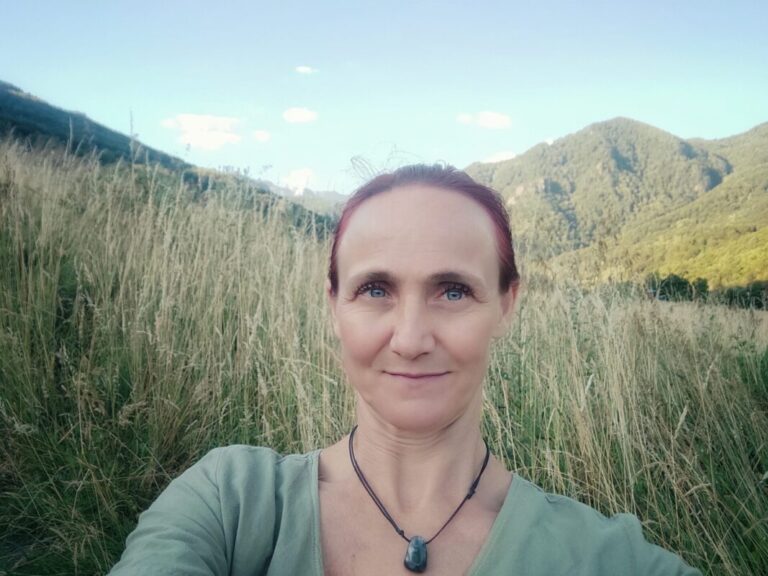
A Little House on MarsIn the poetry collection Polona Campolunghi Pegan’s A Little House on Mars, love begins in the body but does not end at its boundaries. Skin, breath, and touch encounter the sea, the moon, the forest, the desert, and distant planets; the intimate constantly opens up towards the cosmic.
The “little house” of the title is a space for two, but also a space of imagination – a shelter into which one can retreat from everyday roles and where closeness becomes freer for a moment. In the collection, eros intertwines with vulnerability, love with absence, and longing with the awareness that we can never fully possess another person.
A distinctive feature of the collection is its bilingualism. The poems are published in Slovenian and Bosnian, translated by Sonja Cekova Stojanoska, so the dialogue between two people also becomes a dialogue between languages and cultures.
A Little House on Mars is a collection about closeness that needs distance, and about a body that is sometimes too small for everything it feels.
🔴 AWARD-WINNING AUTHOR
Polona Campolunghi Pegan had already attracted literary attention before the publication of A Little House on Mars.
In 2017, her first poetry collection, Dreams of a Pomegranate (Sanje o granatnem jabolku), was selected as the best self-published poetry collection of the year by the magazine Mentor and the Public Fund of the Republic of Slovenia for Cultural Activities (JSKD).
In 2019, she received the Mentorjev feferon award for her protest poem You Know, Little One, We Are No Longer Human (Veš, mali, nismo več ljudje), and in the same year she also received second prize in the Ars Short Story Competition for her text There Were About Eight of Us on the Bus (V avtobusu nas je bilo kakih osem).
A Little House on Mars is her second poetry collection.
Jantarna lastovka: “There Are Days When Everything in the Soul Is Silent Because Too Much Has Been Felt …”
On 28 October 2025, an extensive interview with Polona Campolunghi Pegan was published in Jantarna lastovka to mark the publication of the collection.
In it, the author speaks about the body, longing, the creation of poems, love, the cosmos, and the meaning of the “little house” in the title.
Asked whether A Little House on Mars is a space of safety or exile, she replies:
“A space of safety. And of vitality. A space where you are who you are. Where laughter is easy.”
Speaking about her relationship between the body and the world, she says:
“Above all, I would say that I renounce boundaries.”
It is precisely the removal of boundaries – between the body and nature, the human being and the cosmos, the intimate and the universal – that is one of the collection’s defining features.
Read the interview with Polona Campolunghi Pegan in Jantarna lastovka
Novi glas: “Sometimes It Takes a Very Long Journey to Come Home”
In June 2026, Primož Sturman conducted an extensive interview with Polona Campolunghi Pegan for Novi glas, in which the conversation begins with the very title of the collection.
The poet understands A Little House on Mars as a symbolic home – a space in which a person can set aside the roles of adulthood and rediscover closeness, playfulness, and freedom.
“Sometimes a very long journey is needed just to come home.”
And this thought aptly sums up the collection: Mars is not so much a distant planet as an inner space, one that is sometimes harder to reach than any place on a map.
Read the interview “Sometimes It Takes a Very Long Journey to Come Home” in Novi glas
Poems in Slovenian and Bosnian
Several poems from the collection have been published in Jantarna lastovka, including the cycle Ni vseeno, kakšne barve je morje / Nije svejedno koje je boje more.
It is precisely in these parallel publications that the significance of the collection’s bilingual conception becomes particularly clear. Bosnian does not appear as an addition to the Slovenian original, but creates a second sonic and emotional space for the poems.
One of the characteristic lines reads:
“Stolen time remains / hidden behind the doors of unwritten poems.”
The sea, the body, absence, music, and memory merge in the cycle into a story of two people, one that can be expressed in more than one language.
Read the cycle Ni vseeno, kakšne barve je morje / Nije svejedno koje je boje more
Literary Evening at the Medical Chamber of Slovenia
In May 2026, A Little House on Mars was also presented at the Medical Chamber of Slovenia, connecting the collection with another important part of the author’s life – Polona Campolunghi Pegan is a specialist in family medicine.
The conversation with the author was moderated by Gabriela Babnik Ouattara, the poems were interpreted by Andrej Šubic, with musical accompaniment by Amir Azabagić, and the evening was also attended by the collection’s Bosnian translator, Sonja Cekova Stojanoska.
The Medical Chamber presented the collection as poetry in which eros intertwines with vulnerability, corporeality with myth, and closeness with cosmic distance.
Read about the literary evening at the Medical Chamber of Slovenia
A Little House on Mars in Bovec
The collection was also presented at the Bovec Cultural Centre on 22 May 2026.
The presentation particularly emphasised the space of intimacy and the relationship between two people, as well as the book’s bilingualism, through which a dialogue between languages and cultures emerges.
Here, too, the pronounced corporeality of the poems comes to the fore: skin, breath, and touch intertwine with images of nature, while language becomes both a crack and a bridge.
Presentation of the collection at the Bovec Cultural Centre
Among Readers: “Every Poem a Special Treat”
In January 2026, the author also presented the collection to the Pesem.si community, where it received a very warm response from readers.
One reader wrote:
“A wonderful collection, every poem a special treat.”
Reader responses to the collection on Pesem.si
When the Body Becomes Too Small
Polona Campolunghi Pegan is a physician by training, but the body in her poetry is not a clinical object. Quite the opposite: it is something elusive, porous, and open.
Through the skin enter the sea, the stars, trees, memories, and another person. Love has no clear boundary between “I” and “you”, which is why A Little House on Mars is not a real house either. It is an imaginary space where two people can meet for a moment without all the roles imposed on them by the earthly world.
The collection thus constantly moves between closeness and absence, eros and solitude, the body and the cosmos, Slovenian and Bosnian.
And if Mars is the most distant home we can imagine, perhaps that is precisely why it is also the space of the most intimate question:
Where are we truly at home when we are with another person?